Regulatory Clarity in the US: What It Means for Binance’s Long-Term Strategy

Throughout this year’s World Economic Forum, conversations around digital assets carried a noticeably different tone, which was less defensive and more deliberate. Policymakers, financial leaders, and technologists spoke less about whether crypto should exist within the global financial system and more about how it should be governed as it continues to scale.
That shift was echoed by U.S. officials, including White House digital asset adviser Patrick Witt, who pointed to growing regulatory clarity as a catalyst for renewed institutional confidence. Panels and private discussions alike reflected cautious optimism that the U.S. is moving toward more coherent frameworks that seek to align innovation with investor protection rather than forcing a trade-off between the two.
For global platforms like Binance, these developments matter deeply. As the largest crypto exchange by volume and user base, Binance must continuously assess how regulatory evolution in key markets shapes its long-term strategy. The question is no longer whether regulation will arrive, but what form it will take and how that trajectory will influence Binance’s approach to market access, compliance, and global expansion.
Discussions Centered Around Regulatory Clarity
The official stance at Davos is that 2026 appears to be a pivotal year for blockchain and digital assets. Consequently, crypto was among the most discussed topics at the conference. The consensus was that clearer global regulations, more robust enterprise adoption, along with better system compatibility are the pivotal challenges ahead.
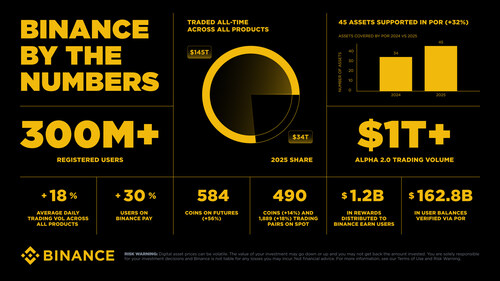
Speaking to CNBC, Binance Co-CEO Richard Teng, remarked that “we are already seeing a convergence of blockchain, tokenization, digital assets with traditional economic services.” Teng went on to say that Binance, which now boasts over 300 million global users, is looking forward “to working closely with governments and corporate parties around the world in terms of not only tokenization, but crypto payments.”
Part of the enthusiasm for movements within the new year, the Binance Co-CEO told an interviewer, was fueled by the fact that last year saw an increase in terms of institutional onboarding on Binance. The trading volume for institutions increased by over 20%. “The momentum is very, very strong,” Teng says.
In December of 2025, Binance received a full set of global licenses in Abu Dhabi, seen by many as a regulatory milestone and a strong mark of legitimacy. For users, this means operating under the oversight of Abu Dhabi’s financial authority. Regarding regulatory practices, Teng says the company is dedicated to “building the best product, with the best compliance, in order to support our customers worldwide.”
Furthermore, discussions at the 2026 World Economic Forum did not fail to mention Binance’s possible re-entry onto the U.S. market. While Richard Teng was measured in his response, he echoed some of the upbeat outlook of many of the other participants at the summit, calling the U.S. “a very important marketplace” and indicating that, for now, the company is taking a “wait-and-see” approach to the issue.
Acknowledging the Growth of the Stablecoin Market
A strong signal of continued U.S. engagement in digital assets came from White House digital asset advisor Patrick Witt, who described 2026 as a pivotal year in cementing crypto’s role within the global financial system. While acknowledging delays in passing key legislation through the U.S. Senate, Witt indicated that regulatory review is expected to resume and emphasized that U.S. agencies intend to play a leading role in shaping global standards.
Stablecoins were a central theme of the discussions. Transaction volumes have surged over the past 24 months, with roughly $24 trillion in 2024 tied to crypto trading and fiat conversion activity. Witt described stablecoins as a practical bridge between traditional finance and decentralized networks, underscoring their growing utility in everyday payments. That trend is already visible in the private sector: stablecoins now make up over 98% of Binance Pay’s business-to-consumer payments, becoming the backbone of digital commerce. While acknowledging ongoing tension between banks and crypto firms, Witt encouraged greater cooperation, noting that expanded choice ultimately benefits consumers.
Increased Focus on Tokenization
The 2026 Davos conference also touched on the major trend of asset tokenization. Tokenization is the process of converting traditional financial assets into digital assets that operate on a blockchain. Trading institutions have recently led the charge in this direction after years of experimentation.
Despite this expansion being impossible to overlook, Larry Fink and Rob Goldstein of BlackRock have argued that progress in the U.S. can be accelerated and that tokenization can vastly expand the universe of investable assets beyond conventional stocks and bonds.
DeFi was also part of the conversation, with recognition that traditional financial institutions, such as JPMorgan and Citi, are already integrating digital assets into their services, and that 2026 could well see a convergence between traditional finance (TradFi) and decentralized finance (DeFi).
Why 2026 May Be a Pivotal Year for Crypto Regulation in the U.S. and Worldwide
It is likely that 2026 will be the year when crypto regulation becomes clearer and corporate actors increase their use of blockchain technology in their daily activities. If the discussions held at Davos are any indication, there are good reasons for crypto users to be excited about the immediate future.
Members of the editorial and news staff of Mediaite were not involved in the creation of this content.)
New: The Mediaite One-Sheet "Newsletter of Newsletters"
Your daily summary and analysis of what the many, many media newsletters are saying and reporting. Subscribe now!








Comments
↓ Scroll down for comments ↓