Why Do Legacy Media Outlets Keep Interviewing Tucker Carlson? (Especially on His Turf)


Screenshot via NPR
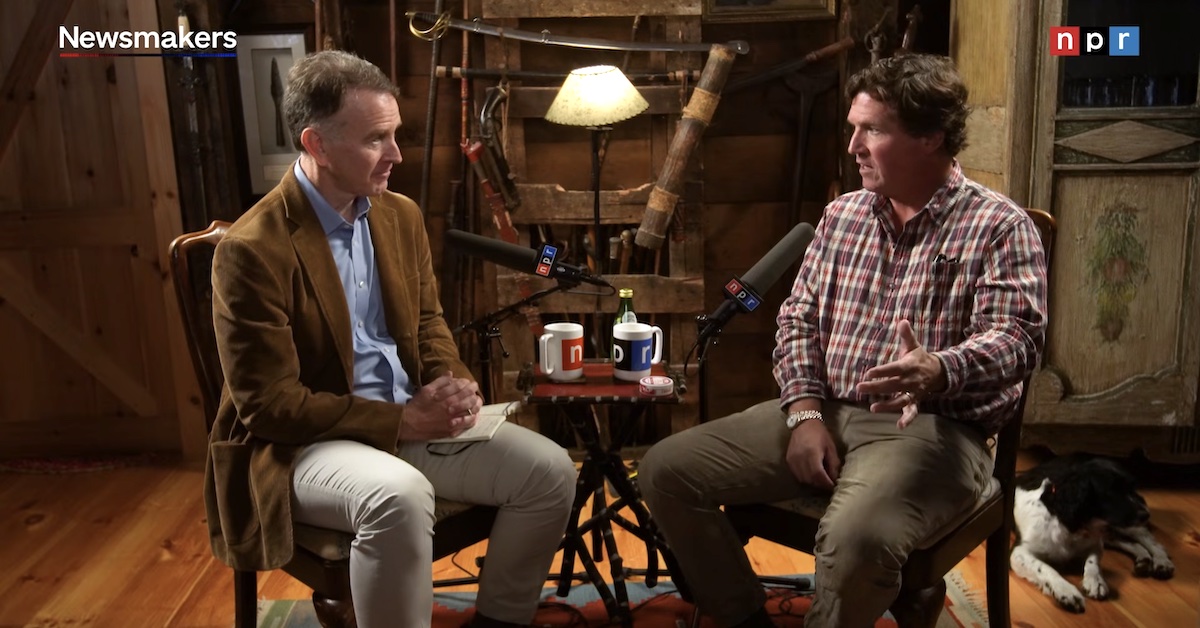
Why do legacy media organizations keep talking to Tucker Carlson? Why do they keep making the trek up to Maine to sit while he holds court in duck boots and flannels, like a Father Coughlin who traded in his frock for pristine outdoorsman gear?
On Thursday, NPR’s Steve Inskeep explained the latest hajj as part of their ongoing series, “Newsmakers,” where they “question some of the most influential people of our time.”
The biggest story out of that interview was that Carlson believes President Donald Trump should be removed from office by his cabinet immediately over threatening Iran with a nuclear weapon. Inskeep jumped in to ask if Carlson was referring to the 25th amendment—and Carlson acceded, “That’s correct.”
That’s it. That’s the news. Every other sentence Carlson says about Trump in that section of the interview is almost verbatim from Carlson’s show on Sept. 1.
The presumption that high-profile media figures—no matter how misguided or malicious—are worthy of the platform and prestige that comes with attention of an outlet like NPR is journalism’s oldest lens, and it has gone cloudy with age. In bygone times, traditionalists could justify putting repellent thinkers under a microscope because there were things yet to be known about their thinking, or because their influence was subterranean and not widely known.
Contrast this with Carlson, who has been a national figure for over 30 years. He broadcasts his opinions daily today and before that, he had a top-rated cable news show. He has written two bestselling books. He competed on Dancing With the Stars. He and I used to co-host a weekly online chat for the Washington Post, in fact, and while I haven’t spoken in almost 20 years, I don’t wonder about what he’s up to—because he is rarely out of the mediasphere. In the past few months, there have been countless breathless squibs about his turn against Trump in major profiles or interviews: the New York Times, the Columbia Journalism Review, Vanity Fair and even another NPR segment with the guy who wrote a Carlson book.
He has been so well-covered for so long that Politico ran a satirical essay presenting itself as a lecture for a journalism class with the sole aim of teaching students how to write about Tucker Carlson. It noted that since Trump was elected,
The Atlantic has published at least seven pieces about Carlson. The New Yorker did a major profile and later published a follow-up. There have been big treatments in GQ, the Columbia Journalism Review, The New Republic, Vanity Fair, and the still-publishing Playboy, as well as Fly Tyer, aimed at fly fishers. Just this year, to cite examples at random, there have been prominent columns in the New York Times and Washington Post.
And that satire was published six years ago.
Carlson attracts journalists because he caters to our egos. Not with compliments, but in the way that a test that looks easy at first glance can make you feel smart. Carlson’s baldly grotesque ideology and the logical leaps in his conspiracy theories seem like trivial challenges. Reporters are easily fooled into thinking they’ll be the one to get him.
So while Carlson wears the Barbour jacket, it’s legacy journalists who think they’re the hunters. They hope to get a bead on Carlson with a well-placed and meticulously researched question. They hope to catch him in a hypocrisy trap. Some sincerely want to capture him as a specimen, bag the beast and take him to the lab.
Carlson has turned on Trump, but he exists in the same amoral slough: You cannot shame someone who doesn’t care what you think. You cannot create backlash against someone whose audience already knows their ugliest beliefs. Those who just want to explore “what makes him tick” are under the grossest delusion: It’s never been a secret. They are not shining a light into a hidden recess, they’re just adding wattage to an existing spotlight.
The New York Times Q&A captured the bizarre lack of stakes in a Carlson interview perfectly: Lulu Garcia-Navarro read him back a quote where he called Trump the antichrist. Carlson replied that he had not said that. Garcia-Navarro reads him the fuller quote. Carlson denies having said it again. She tells him there’s video and he says, “Man, then my apologies to you, if there’s a video of me saying that. I guess what I’m expressing to you is it doesn’t reflect exactly how I feel.”
His viewership did not plummet. He did not amend his views. He just welcomed Inskeep into his studio-cum-barn next.
——
This is an opinion piece. The views expressed in this article are those of just the author.
New: The Mediaite One-Sheet "Newsletter of Newsletters"
Your daily summary and analysis of what the many, many media newsletters are saying and reporting. Subscribe now!

Comments
↓ Scroll down for comments ↓