Tucker Carlson Just Made the Case That Trump Is the Antichrist

Screenshot
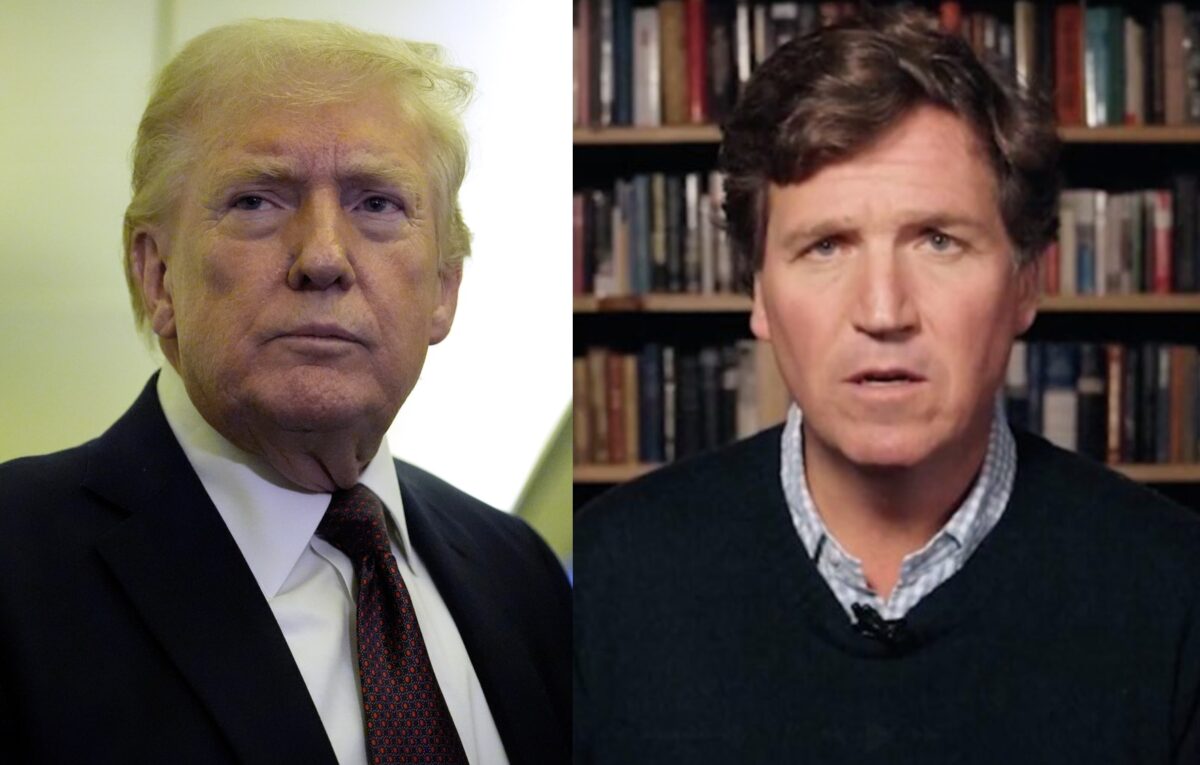
Tucker Carlson openly called Donald Trump evil on Monday.
To be clear, he didn’t say the president was reckless, unhinged, or a foreign policy liability. He said he was evil. Theologically evil. The kind of evil that has a name in the Christian tradition, one Carlson was careful to never say aloud because he didn’t have to. He made his case methodically for 43 minutes and left his audience, arguably the most important segment of American conservative media at the moment, to complete the sentence themselves.
The proximate cause was a Truth Social post Trump dropped at 8 a.m. on Easter Sunday morning. It promised to destroy Iranian power plants and bridges, deployed the word “fucking” in a direct threat to the Iranian government, and signed off with a mocking “Praise be to Allah.” On the holiest morning of the Christian calendar, the president of the United States wrote that, attached his name to it, and hit send.
Of course, that is not a thing that typically happens in American politics. It is certainly not a thing that happens inside the media ecosystem that made Trump’s political dominance not just possible, but persistent. And yet there it was, a monologue that stands as the most theologically loaded and politically calculated attack on Trump from within his own coalition since he came down that escalator.
To be clear, Carlson did not exactly defect from the Trump flock. He was careful about that. But defection would have been less dangerous and arguably, less impactful.
What he did instead was tell the Christians who form the bedrock of Trump’s base that their continued support is no longer a political question. It is a moral one. And he built that case with the specific architecture of Christian theology, methodically, without rage, which is precisely what makes it so striking and so damaging at this particular moment in Trump’s political trajectory. For a movement that has punished dissent as reflexively as breathing, Carlson was handing his audience something it hasn’t had in a decade. A moral exit ramp with theological cover.
He starts with the Easter post itself. Trump dropped it at 8 a.m. on the holiest morning of the Christian calendar, and Carlson reads it aloud, he says, “honestly in horror.” The post promises to destroy Iranian power plants and bridges, closes with a mocking “Praise be to Allah,” and is written in the register of a man who believes consequences are for other people. Carlson doesn’t editorialize immediately. He lets it sit. Then: “That peace yesterday was shattered.”
From there he builds the theological case with the patience of someone who has been thinking about this for a long time. His core claim is that the Bible carries one message across all 66 books: you are not God. The limits it places on human behavior exist precisely because power without submission to something higher destroys everything it touches. Trump’s refusal to place his hand on the Bible at his inauguration, which Carlson says he witnessed from fifteen feet away and said nothing about, was not a quirk or an oversight. “Maybe he didn’t put his hand on the Bible because he affirmatively rejects what’s inside that book.” That line lands differently when you understand where Carlson is going with it.
Then comes Paula White. Trump’s spiritual advisor, on video during Holy Week at the White House, comparing Trump to Jesus while Franklin Graham nods along in the background. Inside evangelical theology that comparison is not hyperbole or awkward flattery. It is disqualifying. The singularity of Christ is not a negotiable doctrine. Carlson’s response is four words: “That is the end.” Not a gaffe. The end of any good faith claim to Christian political legitimacy. “You cannot allow that in good faith,” he says. “If you’re a Christian, you have to say no to that.” It is the hinge on which the entire monologue turns, the moment where theological argument hardens into moral ultimatum.
He never uses the word antichrist. He does something more effective. Deep into the monologue, he invokes Christian dualism with the plainness of a man reading from a textbook: God creates, Satan destroys. Then he describes what Trump wrote on Easter morning. Then he delivers the verdict: “an intentional desecration of beauty and truth, which is the definition of evil.” He has already told us Trump likely rejected the Bible’s authority at his own inauguration. He has already called Paula White’s Jesus comparison sacrilege. By the time he gets to Satan he has been building this architecture for thirty minutes. The conclusion isn’t stated. It doesn’t need to be. Carlson knows his audience knows their scripture.
The verdict, when it finally comes, is unambiguous. “We can’t support that. Under no circumstances can we support that. That is evil.” Not a messaging problem. Not a tactical error. Evil. Said plainly, to the people who twice carried Trump across the finish line, in the language of the faith they believed they were protecting when they voted for him.
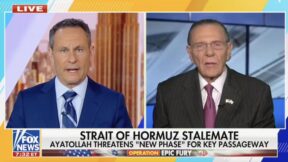
Whether Carlson believes any of it is a legitimate question. He has spent years deploying a kind of tactical nihilism, moving his audience wherever the moment requires. But the context here matters. Carlson went to the White House and argued personally against military escalation in Iran. He lost that argument to Mark Levin, a neocon interventionist with a weekend cable show and Trump’s direct dial. Monday’s monologue is partly a public settling of that private score.
The Levin section is where the monologue becomes something darker than media criticism. Carlson plays a clip from Levin’s Easter weekend show, which Trump explicitly told his followers to watch, in which Levin walks through the Truman precedent: dropping atomic bombs on Japan saved a million American lives, and history called it humane. The implication for Iran is left just implicit enough to be deniable. Carlson makes it explicit. That is the case for nuclear weapons. “All things being equal,” he says, “that’s where we’re heading.”
The MAGA reaction confirmed Carlson hit something real. The intellectual and populist right validated him: Dave Smith called him a modern American hero, the American Conservative amplified his moral case against civilian targeting. The loyalist wing recoiled: Laura Loomer called him “Qatarlson” and demanded ostracism, Nick Fuentes mocked him for defending Islam. The meme-right, ever helpful, weighed in through Catturd, who wanted meaner tweets with more F-bombs.
That fracture is not new. The tension between America First as restraint and America First as dominance has always been there. What’s new is the moment. The Strait of Hormuz remains closed. Trump’s numbers are softening. The coalition looks less monolithic than it did.
That theological case doesn’t go away when the politics get tidied up. Carlson may have lost the argument inside the White House. He may be settling a score with Levin. Both things can be true. But he also just told the Christians who carried Trump across the finish line twice that the man they voted for might be the one their faith warned them about. Levin has Trump’s ear. Carlson has his base. Monday was a reminder of which one of those is harder to replace.
This is an opinion piece. The views expressed in this article are those of just the author.
New: The Mediaite One-Sheet "Newsletter of Newsletters"
Your daily summary and analysis of what the many, many media newsletters are saying and reporting. Subscribe now!




Comments
↓ Scroll down for comments ↓