
Trump’s State of the Union Was a Trap — and Democrats Walked Right Into It

(AP Photo/Alex Brandon)
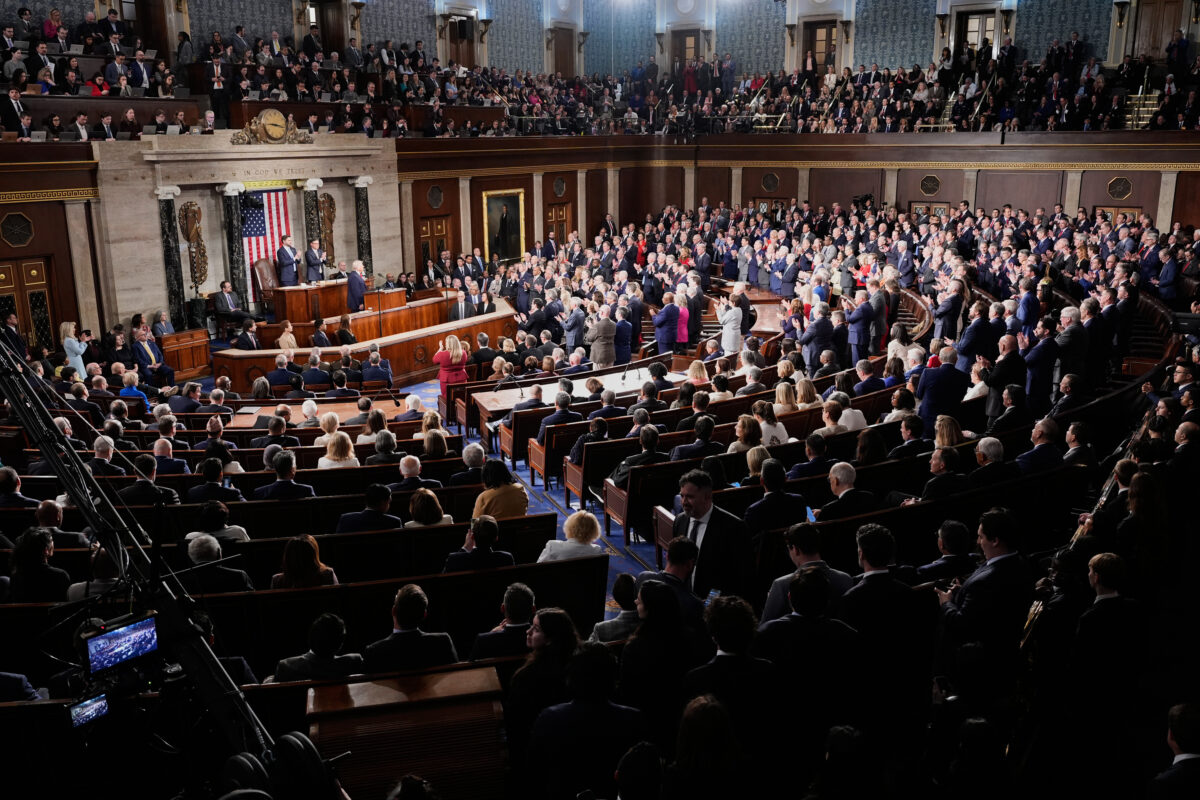
The defining moment of President Donald Trump’s State of the Union came in a pause.
“One of the great things about the State of the Union,” he said, “is how it gives Americans the chance to see clearly what their representatives really believe.” Then he issued the challenge: stand if you agree that the first duty of the government is to protect American citizens, not illegal aliens.
Democrats remained seated.
“Isn’t that a shame?” Trump said. “You should be ashamed of yourself.”
That exchange quickly became the viral clip of the night, but it mattered for a deeper reason. In less than a minute, it crystalized the governing logic of the entire address into a shareable piece of political theater. The confrontation, the moral framing, the visible split in the chamber — it compressed the broader speech into something built for social feeds and cable chyrons. The rest of the evening was scaffolding. That was the load-bearing beam.
From the outset, Trump made clear that this address would not be an effort to broaden his coalition at a moment when his approval numbers remain underwater and independents are uneasy. The speech functioned as an exercise in consolidation. It drew a bright line and invited viewers to choose sides.
Traditional political advice holds that presidents facing soft numbers should pivot toward unification, reassurance and overlap, but that approach grew out of an era when midterms hinged primarily on persuadable voters drifting at the margins. Recent cycles tell a more complicated story. In 2018, Democrats flipped the House on the strength of energized base turnout. In 2022, a widely forecast Republican “red wave” never fully materialized in part because Democratic voters remained intensely engaged. The common thread across recent elections has been the power of mobilized coalitions on both sides, shrinking the relative influence of a movable middle.
Trump appears to be reading that terrain clearly. Expanding his ceiling matters far less than fortifying the floor.
The stand-and-sit moment was engineered accordingly. Democrats had no clean option. Standing would have validated his framing that immigration policy is inseparable from public safety. Remaining seated supplied the image he wanted. The asymmetry was the point — it turned disagreement into spectacle and made posture stand in for principle.
The emotional groundwork had been carefully laid. Trump recounted a succession of violent crimes committed by undocumented immigrants — a fatal truck crash, a stabbing on a train, a murdered teenager, a National Guard ambush — each story vivid and emotionally wrenching. The density of those examples created the impression of a broad and escalating threat. Yet nationally, violent crime remains well below its 1990s peak, and multiple state-level studies, including long-running data out of Texas, show undocumented immigrants are convicted of violent crimes at lower rates than native-born citizens. The contrast between the statistical landscape and the curated sequence of tragedies is not incidental. The speech relied on narrative concentration to produce urgency.
The media environment amplifies the tactic. Trump speaks into a highly responsive ecosystem that carries his framing across television panels, digital platforms, and social feeds almost instantly. Within minutes, the clip of Democrats seated circulated widely, presented as proof that they would not stand for protecting Americans. The visual required little explanation.
In a landscape where narrative velocity far outpaces nuance, the side that produces the most emotionally legible image frequently shapes the first wave of interpretation.
Eight months before midterms, the strategic choice is visible. Rather than use one of the last shared civic rituals to soften partisan edges, Trump used it to energize his coalition and sharpen contrast. The applause lines were calibrated for alignment. The confrontation was deliberate. The viral moment was not incidental to the speech; it was the speech’s essence, compressed into sixty seconds and optimized for circulation.
The pause was the point.
This is an opinion piece. The views expressed in this article are those of just the author.
New: The Mediaite One-Sheet "Newsletter of Newsletters"
Your daily summary and analysis of what the many, many media newsletters are saying and reporting. Subscribe now!






Comments
↓ Scroll down for comments ↓