If the White House Will Lie About Bill Maher Getting an Award, What Won’t it Lie About?

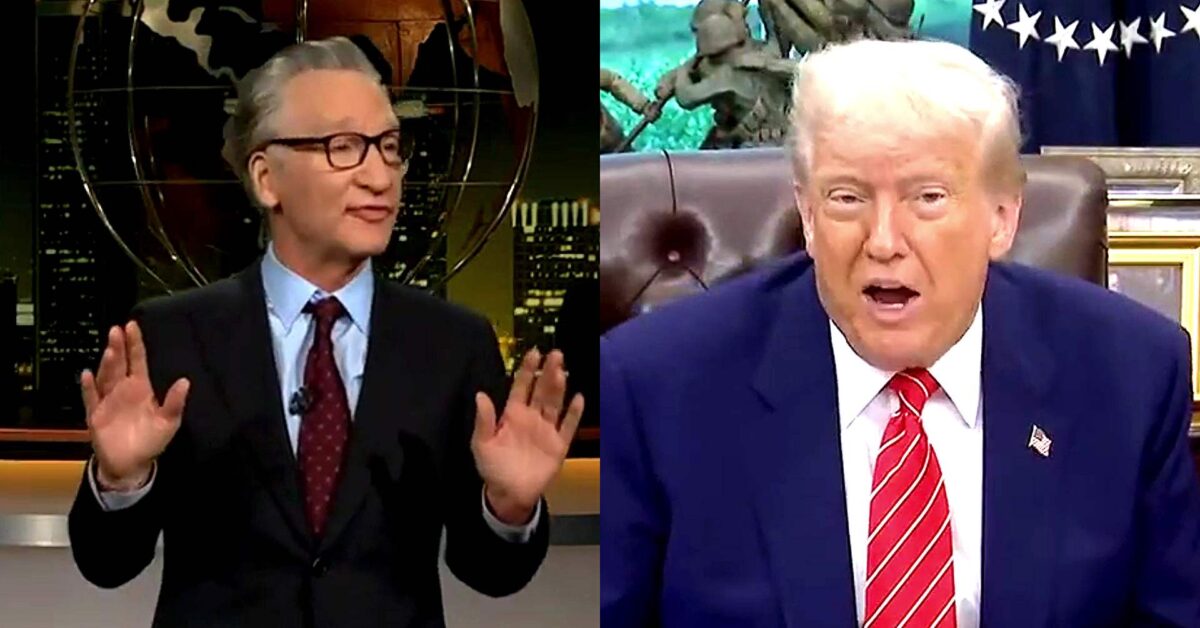
They said it was “literally fake news.” It turned out to be true about a week later. That is the whole story, and also, bizarrely, not the story at all.
Last week, The Atlantic reported that Bill Maher had been selected for the Kennedy Center’s Mark Twain Prize, citing multiple sources and noting that the decision had not yet been formally announced and could still change. A standard piece of careful, conditional reporting about a cultural award. The kind of item that usually floats by.
The White House chose to push back anyway.
Press secretary Karoline Leavitt dismissed the report outright. Communications director Steven Cheung went further, branding it “literally FAKE NEWS” and leaving no room for ambiguity about their position.
Days later, Politico’s Daniel Lippman confirmed the news. Maher is getting the award, with the only real update being that the future eventually arrived.
Let’s start with what didn’t happen. This was not a fast-moving national security story or a leak of sensitive policy deliberations. It was a comedy honor, involving a small circle of decision-makers and a predictable timeline — and a cultural institution close enough to the White House that they should have had a read on it.
Which makes the response harder to explain, not easier.
There are only a few possibilities, and none of them are especially comforting. Maybe they didn’t know. That suggests a surprising blind spot around a high-profile cultural event unfolding within their own orbit. Maybe they didn’t check. That points to something looser — a comms operation that reacts first and verifies later, even when verification is easy and the cost of caution is effectively zero.
Or maybe they understood the reporting was directionally correct and chose to swat it down anyway, because the source was unwelcome or the instinct to call something “fake” has become reflexive.
None of those options describes a system especially interested in being right.
The telling detail is less about White House communications leaders being dead wrong. Officials get things wrong all the time, often for understandable reasons tied to incomplete information or evolving decisions. The telling detail is just how remarkably wrong they chose to be. And just how cocksure they were in being wrong.
There was an obvious, low-risk path. Say the decision wasn’t final. Say there was nothing to announce. Leave room for the process to play out. That is how professional communications operations manage uncertainty.
Instead, the White House opted for theatrical certainty — the kind that can be disproven on a calendar.
That choice suggests something more structural than a one-off miss. The goal does not appear to be aligning public statements with a moving reality. The goal is to control the moment, knock down the report, and signal that the right enemies are being challenged, even if that means letting accuracy take a back seat and racing the clock.
There is a deeper strategic myopia here that’s worth noting as well. Maher is not a conventional media enemy. He had dinner with Trump at the White House. He consistently mocks liberal excess repeatedly, criticizes the left’s messaging failures, and gives the administration real rhetorical cover on more than one occasion. He is not a traditional adversary — he is an occasional ally of convenience, the kind of prominent voice an administration should try to keep warm.
Picking a fight with him over a comedy prize and losing is not just embarrassing. It is terrible math when the Trump admin could use every media ally it can muster.
Of course, no one is going to lose sleep over who gets the Mark Twain Prize. This is not a scandal. It is barely a blip. But it is the kind of small, clean miss that lingers because it is so easy to understand.
They said it wasn’t happening. It happened.
If this is how the machinery works on something this minor, it is reasonable to wonder how it behaves when the stakes are higher and the facts are harder to pin down. Not in a dramatic sense — in a quieter, more corrosive way that accumulates over time.
Credibility rarely collapses all at once. It wears down in moments like this, small and avoidable and entirely self-inflicted.
They called it fake news. It was just the news, slightly ahead of schedule.
This is an opinion piece. The views expressed in this article are those of just the author.
New: The Mediaite One-Sheet "Newsletter of Newsletters"
Your daily summary and analysis of what the many, many media newsletters are saying and reporting. Subscribe now!




Comments
↓ Scroll down for comments ↓