WSJ Files Scathing Motion Against Trump in Epstein Lawsuit, Calls His Claims Dishonest

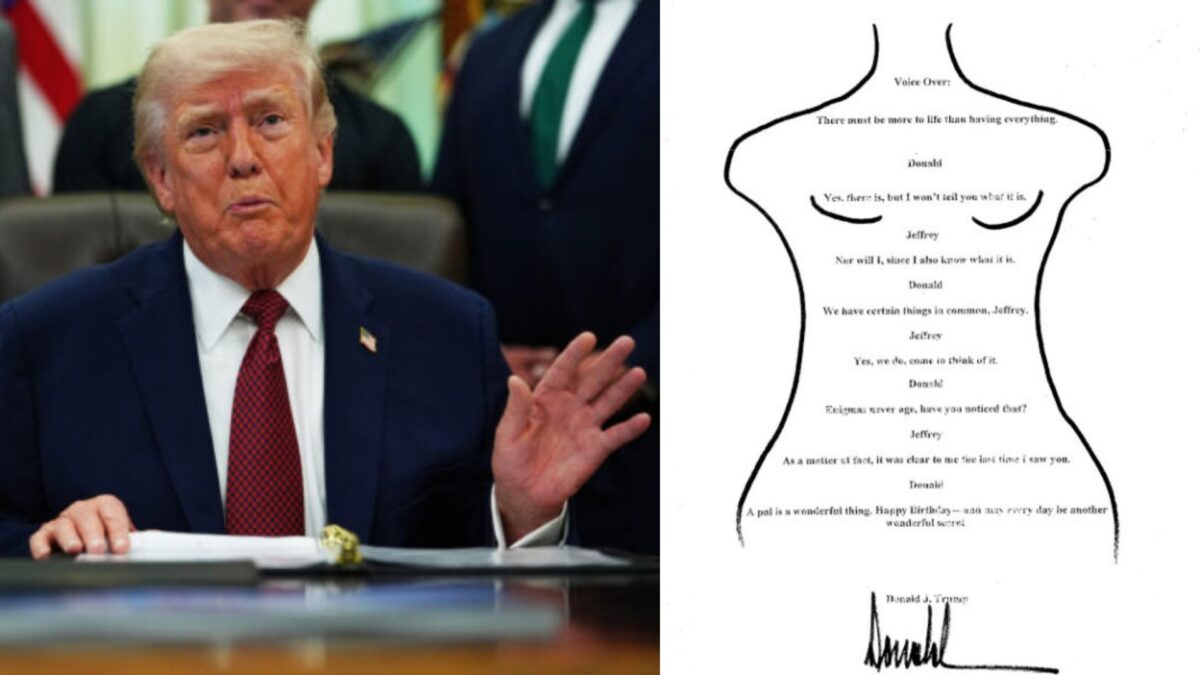
L: AP Photo/Julia Demaree Nikhinson, R: House Oversight Committee
The Wall Street Journal has responded to President Donald Trump’s second attempt to sue for defamation over an article about an infamous note in Jeffrey Epstein’s 50th birthday book, filing a scathing motion to dismiss that excoriates the president’s legal team for “groundless” and dishonest arguments.
In 2025, Trump sued the Journal, the Journal’s publishing firm Dow Jones, parent company News Corp, owner Rupert Murdoch, News Corp CEO Robert Thomson, and two Journal reporters, Khadeeja Safdar and Joe Palazzolo, for defamation. The complaint alleged that a July 17, 2025 Journal article by Safdar and Palazzolo reported that Trump had contributed a letter and a lewd drawing to a birthday album for Epstein, compiled by the convicted sex predator’s accomplice and former girlfriend Ghislaine Maxwell.
Trump vociferously denied the report, threatened to sue, and then did so a day later.
Legal experts were highly skeptical of the lawsuit’s merit from the beginning. Because the president is a public figure, he has to prove the newspaper acted with “actual malice” in order to sustain a defamation claim; it’s a very high bar that political figures often fail to meet when attempting to sue journalists who have criticized them or published unflattering stories.
In September, the House Oversight Committee metaphorically nuked Trump’s case from orbit when it released a trove of materials provided by Epstein’s estate, including the birthday book. Inside the book was a page that said it was contributed by Trump, along with his signature, message, and drawing of a nude female figure — exactly as the Journal’s reporting had described it.
In April, Judge Darrin P. Gayles of the U.S. District Court for the Southern District of Florida, an Obama appointee, dismissed Trump’s complaint, finding that it had “not plausibly alleged that the Defendants published the Article with actual malice.” The judge followed up in May by rejecting Trump’s request to engage in discovery and allowed some additional time to file an amended complaint.
Trump’s 25-page First Amended Complaint, filed in late May, names the same defendants and again alleges the same two claims (defamation per se and defamation per quod), and demands $10 billion in damages.
The Journal defendants filed their response Wednesday: a motion to dismiss and a motion to stay discovery while the court rules on the motion to dismiss.
The 22-page motion to dismiss shredded Trump’s amended complaint because it “does not remedy any of the defects identified” in the court’s order dismissing the original complaint. “In fact, it compounds them,” the motion declared, arguing that this warrants its dismissal with prejudice and an award of attorneys’ fees under Florida’s anti-SLAPP law.
“His case remains groundless” and “baseless,” the motion argued, for three reasons: it “still fails to plausibly plead that Defendants published the Article with actual malice;” “the Article does not have a defamatory meaning,” as “there is nothing defamatory about a
person sending a bawdy note to a friend” (and the article does not claim Trump “personally crafted” the letter); and “the Article was proven true” when the House Oversight Committee released documents including “a letter identical to the one described in the Article.”
“This Court held once that Plaintiff failed to state a defamation claim against Defendants,” the motion continued, and the new amended complaint “only bolsters the conclusion that he can never do so.”
Trump’s attorneys had “significantly misrepresent[ed] the article,” the motion argued in a lengthy section dissecting the claims that the Journal had “failed to investigate” and “omitted” crucial information — both of which were contradicted by the actual contents of the article and failed to meet the “actual malice” legal standard.
The defendants sharply attack Trump’s lawyers for comparing the signature on the birthday card (which simply said “Donald”) to one where the president had signed his full name, instead of the analysis the Journal reporters actually did, which was to compare it to times where he had only signed his first name.
“Plaintiff tellingly does not dispute that resemblance (because he cannot),” the defendants wrote.
Past cases have held that merely “[b]eing friends with someone who may be guilty of criminal activity is not, of and in itself, defamatory,” the motion argued, pointing out that the article had made clear the birthday book predated Epstein’s arrest, as well as Trump’s statement that he had ended the friendship before the arrest — not to mention unchallenged parts of the article and other public reporting that Trump and Epstein had in fact been friends.
Trump’s claimed damages were once again “conclusory” and “devoid of any factual enhancements,” the motion argued (translation: he offered no facts to back up his claims).
The motion concluded by noting that this was a lawsuit “brought by the President of the United States” — arguably the most powerful person on the planet — that directly assaults “the heart of the First Amendment.”
Trump “has now had a full and fair opportunity to plead a defamation claim against Defendants and has twice not done so,” the motion argued, and therefore this “meritless action” should be dismissed with prejudice and fees and costs awarded to the defendants.
New: The Mediaite One-Sheet "Newsletter of Newsletters"
Your daily summary and analysis of what the many, many media newsletters are saying and reporting. Subscribe now!








Comments
↓ Scroll down for comments ↓