Trump’s New Press Sec Says She’s a Lawyer, But There’s ‘No Evidence’ She Ever Passed the Bar Exam: Report

AP Photo/Julia Demaree Nikhinson
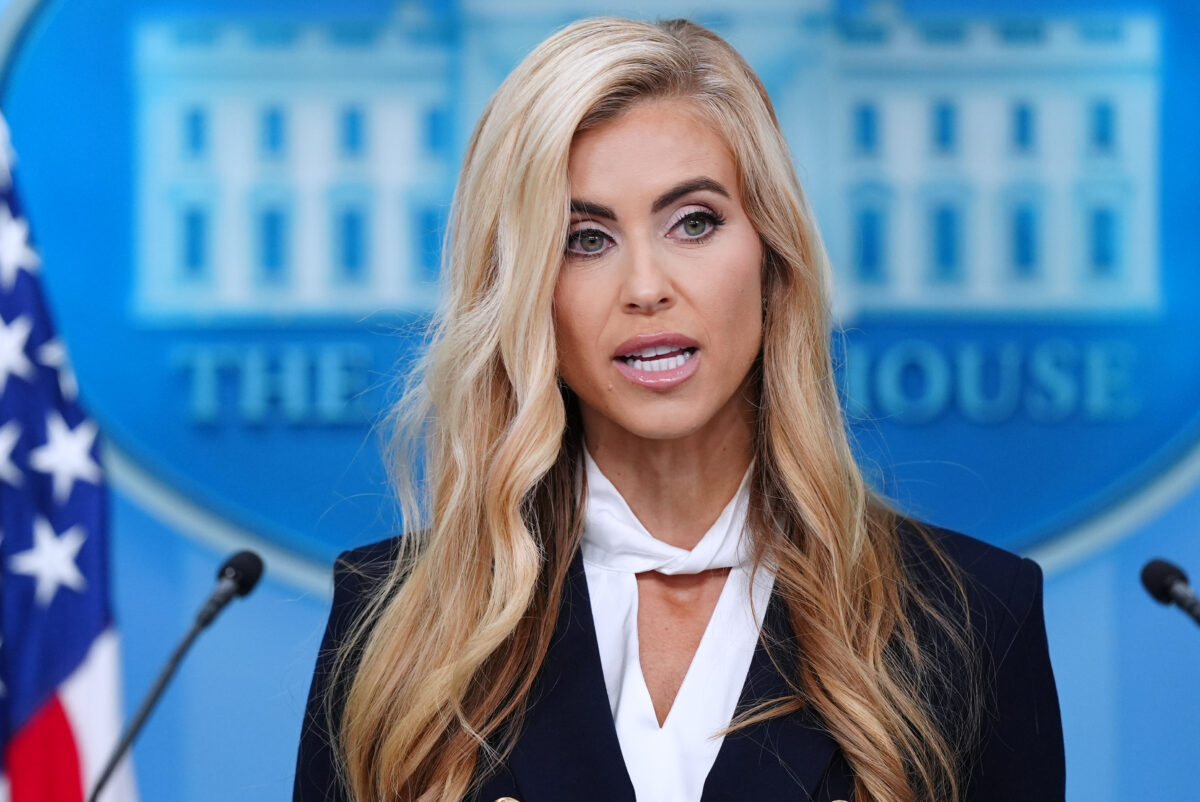
Newly-minted White House Press Secretary Katie Zacharia has repeatedly identified herself as a “lawyer,” but a report by independent journalist Judd Legum says her name does not appear as a member on any state bar association website, and a review by Mediaite of her claims of working as a lawyer in China do not seem to add up.
Zacharia was announced as the latest MAGA mouthpiece for President Donald Trump’s administration earlier this month, taking over after her predecessor Karoline Leavitt resigned after the birth of her second child. She kicked off her tenure presiding over the White House Press Briefing Room Tuesday to decidedly brutal reviews.
As Legum’s report on his Popular Information website noted Tuesday morning, Zacharia has repeatedly publicly identified herself as an “attorney” or “lawyer” (there is no meaningful legal difference between those two terms) during television and podcast appearances.
In Trump’s Truth Social post touting her hiring, he described her as “a distinguished Graduate of Pepperdine University, and the Pepperdine Caruso School of Law, an attorney, and a frequent Commentator on outlets, including Fox News and Newsmax.” Zacharia “was also identified on screen as a lawyer during at least 18 appearances on Fox News since March 2025,” wrote Legum.
However, Legum continued, “there is no evidence that Zacharia ever passed a bar exam or has been admitted to practice law in any state.” The Washington Post independently reviewed state bar listings and confirmed Legum’s reporting, being unable to “find any active or expired bar admissions under Zacharia’s name, including her maiden name, Black.”
Public records show that Zacharia’s residence is in California, and a spokesperson for the State Bar of California told the Post that it “has no record of Kate Sharon Zacharia or Kate Sharon Black having been licensed to practice law in California,” nor did it have any such records under her nickname, Katie.
Zacharia’s LinkedIn profile lists several legal jobs after her graduation from law school in 2011, including working as an “Associate” in the “International Practice Team” for the Zhong Lan Law Firm in Beijing, China and as “General Counsel” for a nonprofit organization called “Fix California.”
As Legum’s report noted, “[I]t is quite plausible for a law school graduate who is not admitted to practice law in any state to work for a firm in China, since the work may not involve American courts,” but she also repeatedly claimed that she was an “outside counsel to the IFC and the World Bank” during this period, a much less believable claim, that two major international institutions would be willing to hire a brand-new law school graduate with no bar admission.
Legum searched for Zacharia’s name on the websites for the State Bar of California, where she graduated and currently lives, and then two other places she has worked, in Texas and D.C. Eventually, he searched all 50 states and D.C. looking for any evidence Zacharia “was admitted to practice law anywhere — and found none.”
There is plenty of evidence Zacharia did attend Pepperdine’s law school and graduate. For starters, she is listed as an alumna member of the school’s “Dean’s Council” as “Katie S. Zacharia (’07, JD ’11);” it is highly unlikely that Pepperdine would not have accurate information on whether it actually granted her a diploma.
But merely graduating from law school and earning a juris doctor degree is not enough to hold oneself out to the public as an “attorney” without also being admitted to a bar association, which generally requires passing a background check and bar exam.
If an attorney is admitted to a bar association and then decides to go voluntarily inactive, or is involuntarily suspended or disbarred from the practice of law, it is standard to still include their name in the bar association’s listings, with the appropriate status designation and any disciplinary history, if relevant.
As an example, Adam Hoffman, the attorney and accused child rapist who received a controversially lenient plea deal from Texas Attorney General Ken Paxton’s office despite admitting that he “with the intent to arouse or gratify my sexual desire, touch genitals of [the victim, identified by initials] …without the complainant’s consent,” was ordered by the judge to surrender his Texas bar license. When Mediaite reviewed the Texas Bar’s online records, Hoffman was listed as “Not Eligible to Practice in Texas” due to “Resignation in lieu of discipline.” He was also admitted in Nebraska and his license is “Regular inactive” there.
Attorneys chose to go inactive for many noncontroversial reasons, including to avoid having to keep up with continuing legal education and trust account reporting requirements if they are in a job that does not have them currently providing legal representation to any clients. I put my own Florida Bar license on voluntary inactive status for several years after shifting to a career in journalism, and until I reactivated my license earlier this year, I was listed on the website as an “inactive” attorney and am now back as a “Member in Good Standing.”
In other words, if Zacharia is not listed on any state bar website, that would seem to indicate she was never admitted in the first place, due to not taking the bar exam, not passing it, or having some issue with her background check and application that caused them to not approve her for admission.
In many states, including California, publicly claiming you are an attorney is a crime, as Legum noted. The California law declares it to be “a misdemeanor punishable by up to one year in a county jail or by a fine of up to one thousand dollars ($1,000), or by both” for “[a]ny person advertising or holding himself or herself out as practicing or entitled to practice law or otherwise practicing law who is not an active licensee of the State Bar, or otherwise authorized pursuant to statute or court rule to practice law in this state at the time of doing so.” Second offenses carry a minimum jail sentence of 90 days.
Bar associations’ professional responsibility and ethics rules put the burden of compliance on the attorney to accurately inform the public of their status. Zacharia has been, as Legum pointed out, identified as an “attorney” or “lawyer” in many media appearances, but that would have come from information she provided to the media outlets. (I do not recall any television, radio, podcast, or other interview I have ever done that asked me to verify my job title or membership status with the Florida Bar, and would not reasonably expect a media outlet to do so for guest commentators.)
Legum reached out to White House Principal Deputy Press Secretary Anna Kelly for comment on Zacharia’s status, “including whether she was ever admitted to practice law in any state,” and received a response from “a general White House Press Office email account” that directed him to “the President’s TRUTH on Katie,” referring to Trump’s social media post that called her an “attorney.”
Late morning Tuesday, Trump and Zacharia spoke to the media outside the White House before traveling to Alaska, and the gathered reporters shouted several questions asking where she passed the bar exam.
The audio is difficult to hear, but it appears Zacharia replied, “when I moved to China,” presumably referring to her work for the law firm in Beijing.
Admittance to a foreign bar association would not entitle her to practice law in the U.S. at all, obviously, but it is still not clear what, if any, status Zacharia had in China.
China is very restrictive about who is allowed to practice law and does not allow noncitizens to become lawyers or even sit for the bar exam. Foreigners already admitted to practice law in another country can provide advice about their own jurisdiction to clients in China but must have already practiced law for at least two years in their home country first before legally being allowed to practice as a “Foreign Representative Attorney.”
Zacharia’s LinkedIn profile says she graduated in 2011 and started working for the Beijing firm a few months later; she does not list any job before then that appears to meet the two-year requirement.
Mediaite was unable to find any reporting suggesting that Zacharia has dual U.S.-Chinese citizenship, but even if she did, she still would have had to complete a one-year internship at a Chinese law firm (and pass the Chinese bar exam, the “National Unified Legal Professional Qualification Examination,” which is only administered in Chinese), before being admitted to practice.
In an article at the South China Morning Post flagged by independent political reporter Roger Sollenberger, the Zhong Lun law firm where she says she worked is described as “one of China’s leading law firms.”
Sida Liu, a professor of law and sociology at the University of Hong Kong, described Zhong Lun as an elite law firm that is “often grouped among the country’s so-called red circle firms – a term roughly comparable to the ‘magic circle’ firms in London or ‘white shoe’ firms in New York.” Liu commented that it became common practice over the past decade for such firms to be “expanding their international practices and hiring foreign-trained lawyers to support cross-border work.” It is common for such Chinese firms to hire foreigners as law clerks, research assistants, consultants, or some other non-lawyer role, but again, that is not actually practicing law.
Notably the South China Morning Post’s report does not quote any sources, even anonymously, who had direct knowledge of Zacharia’s work in China, although the article does say that she “reportedly knows enough basic Chinese to occasionally interject in a conversation and catch people off guard,” describing her language knowledge as “basic” and not at the level of fluency needed to “conduct complex diplomatic or legal discussions in Chinese.”
If in fact Zacharia has not been admitted to any bar association but does want to be at some point in the future, her numerous public representations she was already an attorney could end up being a big problem for her. Many attorneys have managed to get admitted to the bar despite past histories of crimes or ethical violations — with the expectation that they disclose such incidents in their applications and express remorse and a commitment not to repeat such offenses — but bar associations tend to crack down hard on those attempting the unauthorized practice of law or otherwise falsely publicly claiming to be attorneys.
As Tuesday rolled on, Zacharia made claims to several reporters that she had “practiced international transactional law, with all the appropriate credentials;” when asked to clarify what state bar she had passed, a White House official claimed she “worked on international transaction law.”
The Washington Post’s Scott Nover interviewed several legal ethics experts about Zacharia’s claims to be a lawyer. These experts said “if a person is not a licensed lawyer but is identifying as one, that presents serious ethical and legal problems,” he wrote.
The experts, including multiple law school professors, emphasized that merely earning a law degree does not entitle someone to call themselves a lawyer. Wrote Nover:
A person is considered a lawyer or an attorney only after being admitted to practice law, said [Bruce A. Green, the director of the Louis Stein Center for Law and Ethics at Fordham University School of Law], adding that in most states, this requires passing a bar exam and demonstrating proper character.
Leonard M. Niehoff, a professor at the University of Michigan Law School, said that there is a “world of difference” between having a law degree and being a licensed attorney. And, he said, there could be consequences for falsely claiming to be a licensed attorney.
…
Even if Zacharia were licensed in another country, Green said, her public statements in U.S. media would still be misleading if she did not say that she’s not licensed in the United States.
“Someone in the U.S. who just flat-out calls themselves a lawyer, without further qualification or explanation, will mislead listeners or readers to think that they are permitted to practice law here in the U.S. — which they are not,” he said.
Watch the clip above via CNN.
This article has been updated with additional information.
New: The Mediaite One-Sheet "Newsletter of Newsletters"
Your daily summary and analysis of what the many, many media newsletters are saying and reporting. Subscribe now!





Comments
↓ Scroll down for comments ↓