Federal Judge Shuts Down Trump’s Discovery Request As He Attempts to Salvage Suit vs. WSJ: ‘Expensive Yet Groundless Litigation’

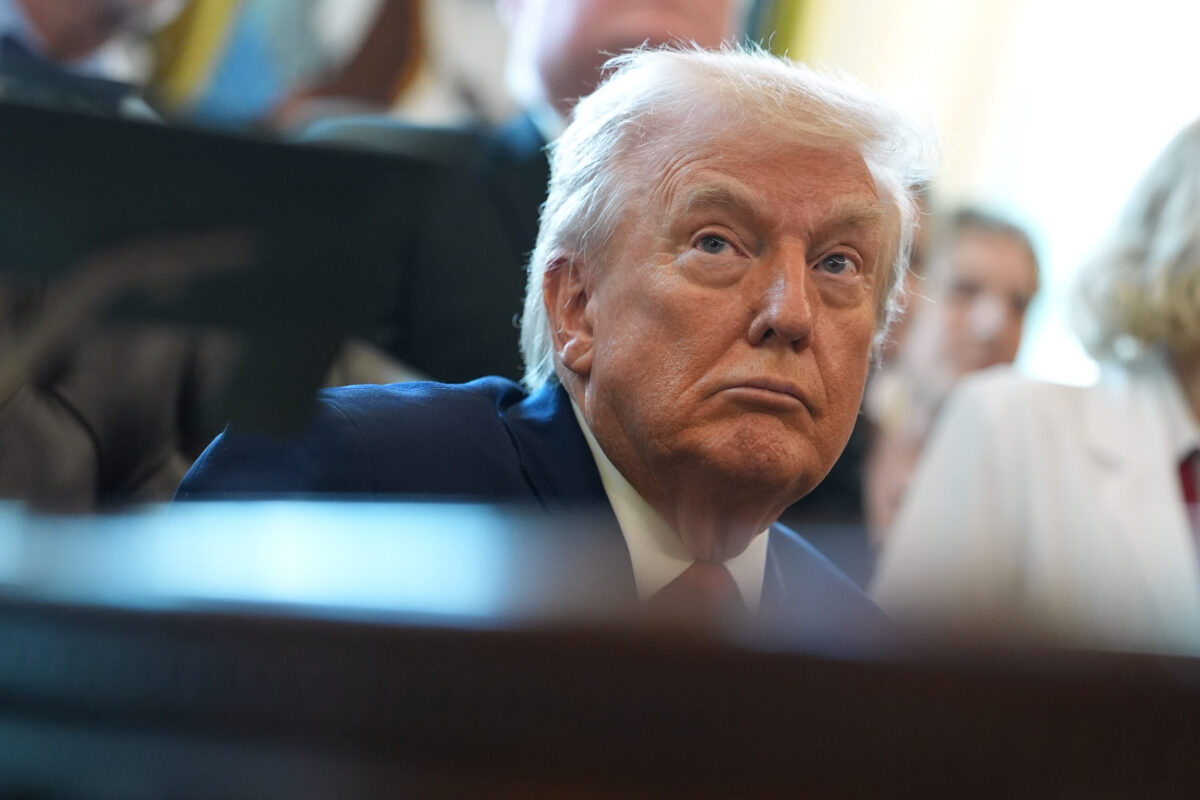
AP Photo/Evan Vucci
A federal judge in Florida smacked down President Donald Trump’s discovery request, which he filed in an attempt to salvage his defamation lawsuit against The Wall Street Journal, but did grant him additional time to file an amended complaint.
In 2025, Trump sued the Journal, the Journal’s publishing firm Dow Jones, parent company News Corp, owner Rupert Murdoch, News Corp CEO Robert Thomson, and two Journal reporters, Khadeeja Safdar and Joe Palazzolo, for defamation. The complaint alleged that a July 17, 2025 Journal article by Safdar and Palazzolo that reported Trump had contributed a letter and a lewd drawing to a birthday album for Jeffrey Epstein, compiled by the convicted sex predator’s accomplice and former girlfriend Ghislaine Maxwell.
Trump vociferously denied the report, threatened to sue, and then did so a day later.
Legal experts were highly skeptical of the lawsuit’s merit from the beginning. Because the president is a public figure, he has to prove the newspaper acted with “actual malice” in order to sustain a defamation claim; it’s a very high bar that political figures often fail to meet when attempting to sue journalists who have criticized them or published unflattering stories.
In September, the House Oversight Committee metaphorically nuked Trump’s case from orbit when it released a trove of materials provided by Epstein’s estate, including the birthday book. Inside the book was a page that said it was contributed by Trump, along with his signature, message, and drawing of a nude female figure — exactly as the Journal’s reporting had described it.
Last month, Judge Darrin P. Gayles of the U.S. District Court for the Southern District of Florida, an Obama appointee, dismissed Trump’s complaint, finding that it had “not plausibly alleged that the Defendants published the Article with actual malice.”
Gayles granted Trump leave to file an amended complaint, and the president responded by filing a motion for additional time and a request for limited discovery on “[h]ow each Defendant acted with actual malice,” “[h]ow Defendants purposefully avoided the truth of the statements at issue,” and “[h]ow Defendants allegedly obtained the letter and supposedly verified its contents, including Plaintiff’s signature.”
Generally in civil litigation, a plaintiff has to have the basic elements of their claims ready in their complaint. The courts are fully aware that litigation can be expensive and burdensome, especially complying with discovery (subpoenas for documents, testifying in depositions, etc.); they will not allow a “fishing expedition” by a plaintiff who says he’s been wronged but can’t spell out how or who is at fault.
In a three-page order, Gayles applied this reasoning to reject Trump’s arguments for discovery. The president was currently “without an operative complaint,” since it had been dismissed in April, and now “seeks discovery to help him properly plead his claims,” the judge wrote. “But this is improper.”
Allowing Trump to engage in discovery before showing he could properly plead his claims in an amended complaint “contravenes the purpose behind the actual malice standard,” Gayles wrote, quoting from his order dismissing Trump’s complaint on why a higher standard is applied to public figures:
[T]here is a powerful interest in ensuring that free speech is not unduly burdened by the necessity of defending expensive yet groundless litigation. Indeed, the actual malice standard was designed to allow publishers the “breathing space” needed to ensure robust reporting on public figures and events. Forcing publishers to defend inappropriate suits through expensive discovery proceedings in all cases would constrict that breathing space in exactly the manner the actual malice standard was intended to prevent. The costs and efforts required to defend a lawsuit through that stage of litigation could chill free speech nearly as effectively as the absence of the actual malice standard altogether.
“Thus, allowing President Trump to conduct discovery on actual malice, where his initial attempt at pleading a defamation claim fell short, is exactly the type of ‘expensive yet groundless litigation’ the Eleventh Circuit has cautioned against,” the judge concluded.
Gayles denied Trump’s request for discovery and granted a short extension of time to file an amended complaint, with the new deadline set for May 27.
Order denying Trump’s discovery request in WSJ defamation lawsuit by sarahrumpf
—
New: The Mediaite One-Sheet "Newsletter of Newsletters"
Your daily summary and analysis of what the many, many media newsletters are saying and reporting. Subscribe now!







Comments
↓ Scroll down for comments ↓