Prosecutor from Chicago ICE Protest Case Blasts Trump-Appointed Boss for Falsely Accusing Her of Misconduct

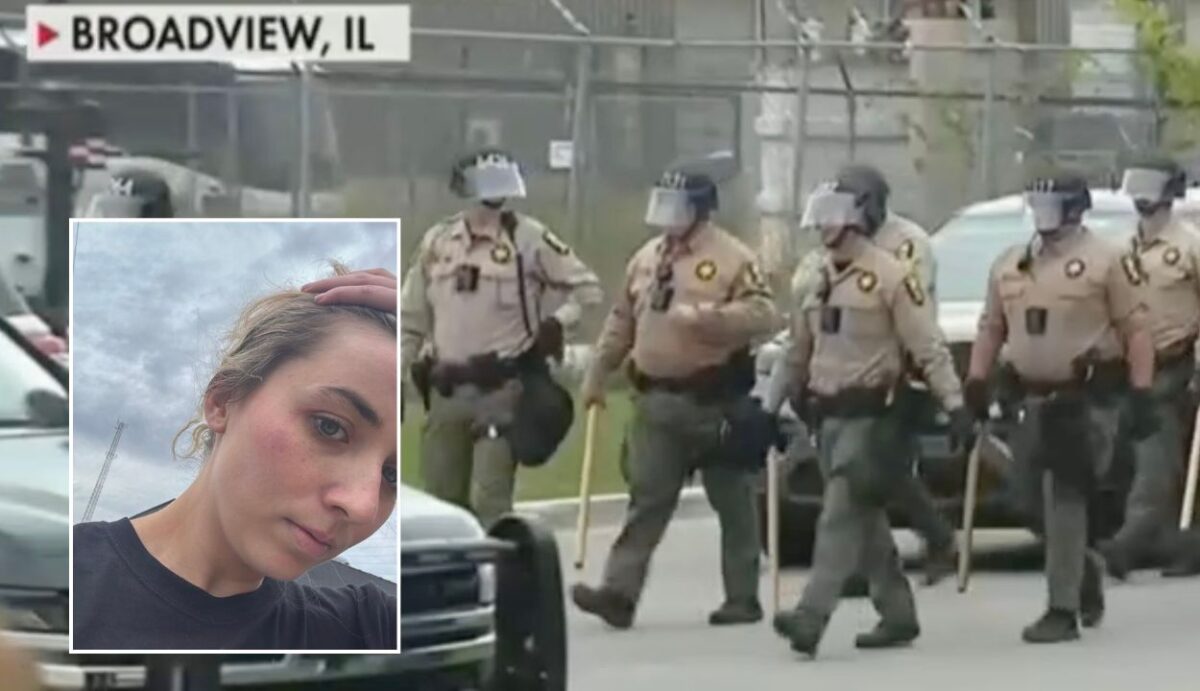
Sheri Mecklenberg, a career prosecutor with the Department of Justice, submitted a scathing letter Thursday announcing she was retiring “under protest” and blasting her boss, U.S. Attorney Andrew Boutros, a Trump appointee, for directing her to pursue felony charges in a controversial case and trying to prevent her from defending herself against accusations of misconduct.
The triggering event was a case that derived from an altercation at the Broadview ICE detention center in a suburb of Chicago between federal agents and Democratic activist protesters that resulted in six people being charged for allegedly “physically hinder[ing] and imped[ing] a federal agent’s vehicle. Among those charged was then-Democratic congressional candidate Kat Abughazaleh.
Long story short, the entire case imploded in May when Judge April Perry with the U.S. District Court for the Northern District of Illinois, a Biden appointee, hauled in the prosecutors from President Donald Trump’s Department of Justice to demand an explanation for improprieties in the grand jury proceedings.
Mecklenberg and the other prosecutors on the case had turned in transcripts from the grand jury proceedings that were redacted and the judge found that unacceptable, demanding the full transcripts. Boutros ended up permanently dismissing all remaining charges against the defendants and was sharply scolded by the judge.
The “trust had been broken” between the prosecutors and the court, Perry said, commenting that she had “never seen the types of prosecutorial behavior before a grand jury that I saw in those transcripts,” lambasting the prosecutors for moments where they made improper comments to the grand jury, misrepresented or withheld information, or otherwise failed to meet their ethical and professional obligations. One specific issue was the multiple attempts the feds made to get the indictment, including failing to inform the grand jury of the prior no true bill that had been returned when the initial grand jury rejected the charges.
Mecklenberg is now leaving her position at the DOJ, according to a letter she wrote yesterday that was obtained by The New York Times.
In the letter, Mecklenberg says she has “served well” and is “proud” of her more than 27 years as a public servant, writes that she is “retir[ing] under protest from DOJ, effective immediately,” and then delves into the reasons why — pointing a sharp finger of blame directly at Boutros.
According to Mecklenberg, she wanted to defend herself against the “continuing allegations” of “pervasive misconduct” and other “false and inflammatory accusations” that the defendants’ lawyers were asserting against her.
“Those false accusations include that (1) I ‘sat silently by’ while the Court addressed transcript redactions— when I was unaware of both the redactions and the hearings; and (2) I ‘outright lied’ to the grand jury—which I did not,” wrote Mecklenberg.
Her efforts to submit filings defending herself were blocked; according to Mecklenberg, a senior official said that “as a current DOJ employee, I am prohibited from filing anything to defend myself and will be disciplined and/or terminated if I do so.”
“I therefore am retiring under protest; effective immediately, because rețirement is the only way to preserve my continued healthcare benefits, earned over decades of service,” she wrote. “This is not a voluntary departure. If you carry through on your threat to terminate me, I will lose those benefits. If I do not retire now, I cannot defend myself. You have forced me to choose between remaining silent while my professional reputation is destroyed and prematurely surrendering my cherished career.
I choose the latter.”
Refusing to let her defend herself was “particularly reprehensible,” she continued, because of the US Attorney’s Office’s “failure to adequately defend me.” She described how she had “repeatedly sought guidance” from the senior officials, including Boutros, and followed their directions, but they had submitted a response without consulting with her or her attorneys. That filing “did not fully present the facts supporting my conduct,” she wrote, and “now [the Office] seeks to prevent me from presenting those facts myself.”
Mecklenberg further accused Boutros of directing the transcript redactions that so incensed the judge without ever consulting her and failing to notify her of the May court hearing where her “conduct and reputation” were on the line; “I had the indignity of learning about [the hearing] after-the-fact from the media,” she wrote.
Instead, Mecklenberg asserted, her absence at that hearing meant that she “was a convenient target to be scapegoated and publicly vilified,” directly blaming Boutros for that, the subsequent actions he took that targeted her, and for pushing the case to have felony charges in the first place:
You recklessly agreed in court that I had committed misconduct without even asking for my account, fully reviewing the record or briefing the law. That evening, you sent an office-wide email laying responsibility at my feet for a felony prosecution that you personally directed over my objection that the case was better suited to misdemeanor charges. You then publicly announced an investigation of my conduct spanning twenty years. These inexplicable actions severely damaged a reputation I worked hard to build over decades and have damaged my prospects for future employment and income.
Mecklenberg had “remained silent,” she wrote, but the defense counsel were now bringing “additional false and inflammatory accusations against me that the Office has not rebutted and apparently has no intention of rebutting,” even going so far as to “have threatened to terminate me if I attempt to rebut the false allegations and bring additional matters to the Court’s attention.”
She further complained about Boutros having “placed me on leave and cut off my devices and credentials without any notice,” and still not providing any written notice for the reasons she was put on leave, or why she was the only one put on leave.
“I am retiring specifically because you have made retirement the only way for me to defend myself without forfeiting the healthcare benefits I earned through decades of government service,” she wrote.
Mecklenberg acknowledged not “every word I used or everything I did before the grand jury was done perfectly” and said she was “prepared to address legitimate scrutiny of my actions,” “[b]ut legitimate scrutiny is not the same as scapegoating, and accountability does not require silence in the face of demonstrably false accusations.”
She concluded the letter by repeating that this was notice of her “retirement under protest, effective immediately,” and asking Boutros to tell her legal counsel how to arrange to retrieve her personal belongings from her office.
New: The Mediaite One-Sheet "Newsletter of Newsletters"
Your daily summary and analysis of what the many, many media newsletters are saying and reporting. Subscribe now!






Comments
↓ Scroll down for comments ↓