Supreme Court Says Trump Ballroom Construction Can Proceed, But Roberts Issues Sharp Dissent Calling It ‘Likely Unlawful’

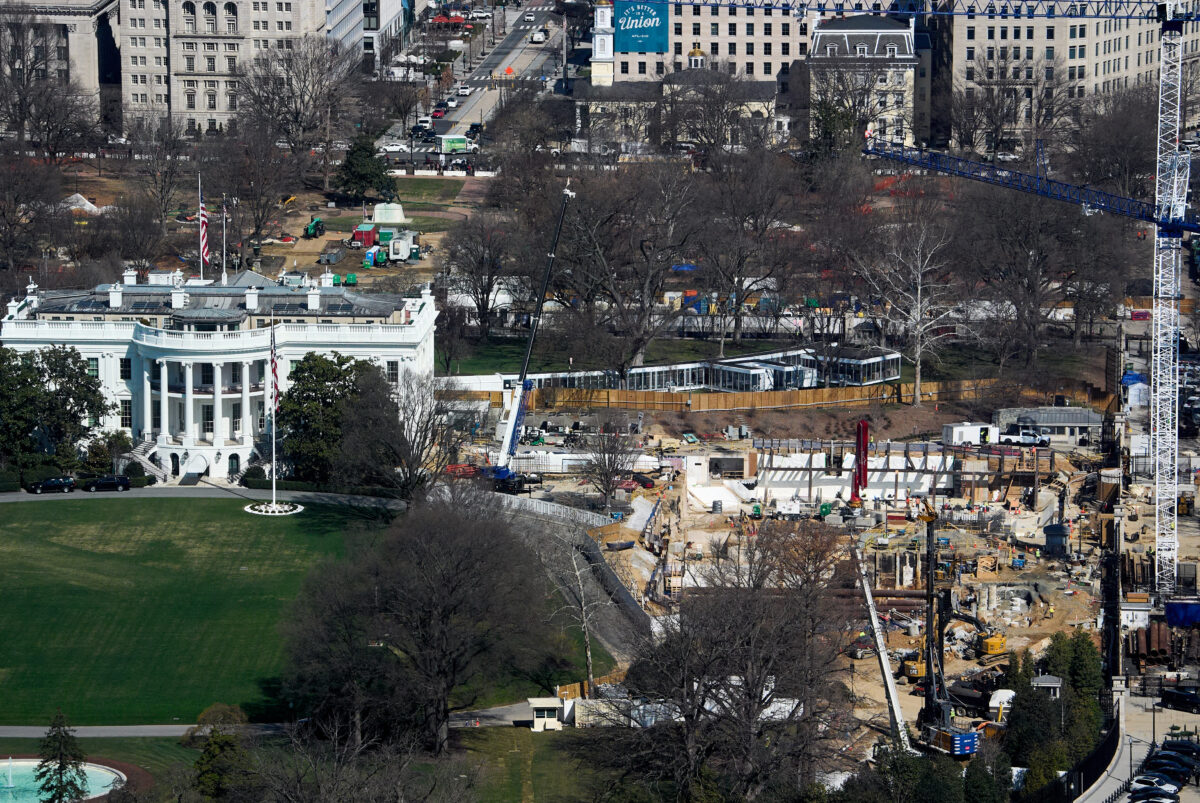
(AP Photo/Jacquelyn Martin)
The Supreme Court ruled Monday that the construction of the White House ballroom could continue, but notably Chief Justice John Roberts dissented, joined by the liberal justices, in expressly declaring that the construction was “likely unlawful.”
The opinion came in connection with a lawsuit that was filed by the National Trust for Historic Preservation in December, arguing that President Donald Trump’s administration had violated federal law in demolishing part of the White House and beginning construction on the ballroom without approval from Congress and satisfying other legal requirements.
Monday’s ruling follows an order by Roberts earlier this month that allowed construction to resume while the parties battled it out, staying a preliminary injunction issued by the district court and affirmed by the U.S. Court of Appeals for the District of Columbia that blocked above-ground construction.
In the latest move from the nation’s highest court, the majority granted the Trump administration’s motion, finding that “[t]he government has established that it is likely to succeed on the merits of a significant legal question, that it would likely suffer irreparable harm without a stay, and that the balance of equities tips in its favor.”
That ruling was issued a per curiam opinion, meaning from the court but not signed by any specific justice.
Roberts, however, did put his name as the author of a sharply-worded dissent, and was joined by his colleagues appointed by Democratic presidents: Justices Sonia Sotomayor, Elena Kagan, and Ketanji Brown-Jackson.
The construction of the ballroom “is likely unlawful,” Roberts wrote in the dissent, citing federal law:
Pursuant to its plenary constitutional authority over the District of Columbia and federal property, Congress has explicitly prohibited the construction of any “building or structure… on any reservation, park, or public grounds of the Federal Government in the District of Columbia without express authority of Congress.”. 40 U. S. C. §8106. The ballroom is a building or structure being erected on federal park grounds—President’s Park—in the District of Columbia. Yet Congress has not passed any law resembling “express authority” for the Executive’s construction of it.
Roberts went on to reject arguments from the government, finding an “apparent absence of statutory authority” and stating that a congressional appropriation “of a couple million dollars for ordinary Executive Residence maintenance and repairs likely does not authorize the President to use hundreds of millions of dollars in private donations to tear down the East Wing and construct a ballroom in its stead.”
Furthermore, Roberts argued, the legal authority for the National Park Service to manage national park land “is likely not express authorization to raze the East Wing and replace it with a ballroom.”
Roberts directly disagreed with the majority’s analysis of whether the National Trust had standing to sue to protect the White House, finding that the “aesthetic injury from the construction of the ballroom is concrete and particularized” and the plaintiff had stated a “focused and substantiated interest in viewing it in its traditional form” and “is deeply committed to the preservation of such historic American buildings.”
“The White House is an iconic American building whose symbolism and history are wrapped up in its architecture,” wrote Roberts, and quoted one of Trump’s predecessors and Winston Churchill (citations omitted):
As President Theodore Roosevelt once remarked while thanking Congress for expressly appropriating funds for the construction of the East and West Wings: “The stately simplicity of [the White House’s] architecture is an expression of the character of the period in which it was built, and is in accord with the purposes it was designed to serve. It is a good thing to preserve such buildings as historic monuments which keep alive our sense of continuity with the Nation’s past.” …
The White House is not just any building, and—when it comes to historic preservation—[Plaintiff] is not just any person. In failing to appreciate as much, the Court misconceives the plaintiff’s injury, allowing the Executive’s likely infringement of the Legislature’s power of the purse and authority to regulate federal property in the District of Columbia to continue. Today’s decision is no victory for the separation of powers.
Winston Churchill once remarked that “[wle shape our buildings, and afterwards our buildings shape us.” All the more reason to ensure that those responsible follow the rules in deciding what to tear down and what to build up at the People’s House.
I respectfully dissent.
The ballroom has been a pet project for Trump, who boasted last year it would be “absolutely magnificent construction” and “one of the best anywhere in the world.” More recently, the president has also argued the project is necessary for national security reasons.
But the project sparked significant controversy, chiefly Trump’s broken promise that the construction “won’t interfere with the current building” and would be “near [the East Wing] but not touching it.”
Instead, very soon after Trump made that public vow, the façade was demolished, then an additional major section, and eventually the East Wing was demolished in its entirety.
The president also initially touted the project as being funded by private donors, but the specifics remained murky, and the endeavor has raised ethical questions about conflicts of interest.
In its complaint, the National Trust argued the project had violated federal law by failing to obtain congressional approval and failing to submit plans to the National Capital Planning Commission and the Commission of Fine Arts, and was a violation of the National Environmental Policy Act, because the White House did not conduct and publish the required environmental assessment before demolishing the East Wing and disposing of the construction debris.
“No president is legally allowed to tear down portions of the White House without any review whatsoever — not President Trump, not [former] President Joe Biden, and not anyone else,” the complaint declared.
This is a breaking news story and has been updated.
New: The Mediaite One-Sheet "Newsletter of Newsletters"
Your daily summary and analysis of what the many, many media newsletters are saying and reporting. Subscribe now!











Comments
↓ Scroll down for comments ↓